Hypercells
generative-systems 10/2026- Year
- 2026
- Location
- Berlin, Germany
- Scale
- 128k to 1024k particles per build; 1,000,000 particles in the 4K build
- Technology
- WebGL2 GPU particle-life (physarum) with an evolvable 80-float Fourier steering rule and machine-driven shader evolution
- Resolution
- 4K UHD (3840 × 2160)
Live version
Live WebGL2 build — click into the view, then press H to open the control panel · open full screen ↗
Hypercells is a generative software series by Studio A N F, first released in 2026 from the studio in Berlin. Each piece is a self-contained WebGL2 application in which hundreds of thousands of GPU particles deposit velocity into a decaying flow field and steer through an evolvable 80-float Fourier rule. The work is shown on screens as a live, non-repeating particle system rather than a rendered video.
How to use the live version
The live build at the top of this page is the baseline interactive configuration of the engine: 600,000 particles in a 1,024 × 1,024 field, delivered as a single self-contained WebGL2 file with no external assets and no network calls. The control panel is hidden by default; click into the view to give it keyboard focus, then press H to open it in the top-right corner. Every change applies on the next frame.
- Organism — the cohorts slider sets how many colour groups share the field (1–24); N generates a new random rule and M mutates the current one.
- Physics — sensor angle, distance and gain set how each particle reads the field; force, axial, lateral, drag and strafe set how it moves; mutation sets how far each cohort’s rule drifts; hazard adds random resets.
- Field & render — trail persistence sets how long the flow field remembers; brightness, accumulation (long exposure), particle size and opacity set the look.
- Transport — pause (space), reset (R), toggle particles / field view (F) and hard pixels (P).
- Draw mode — press D or the draw button, then drag inside the view to push the flow field and herd the particles.
- Left alone, the build mutates its own rule every 90 seconds, so a run never repeats.
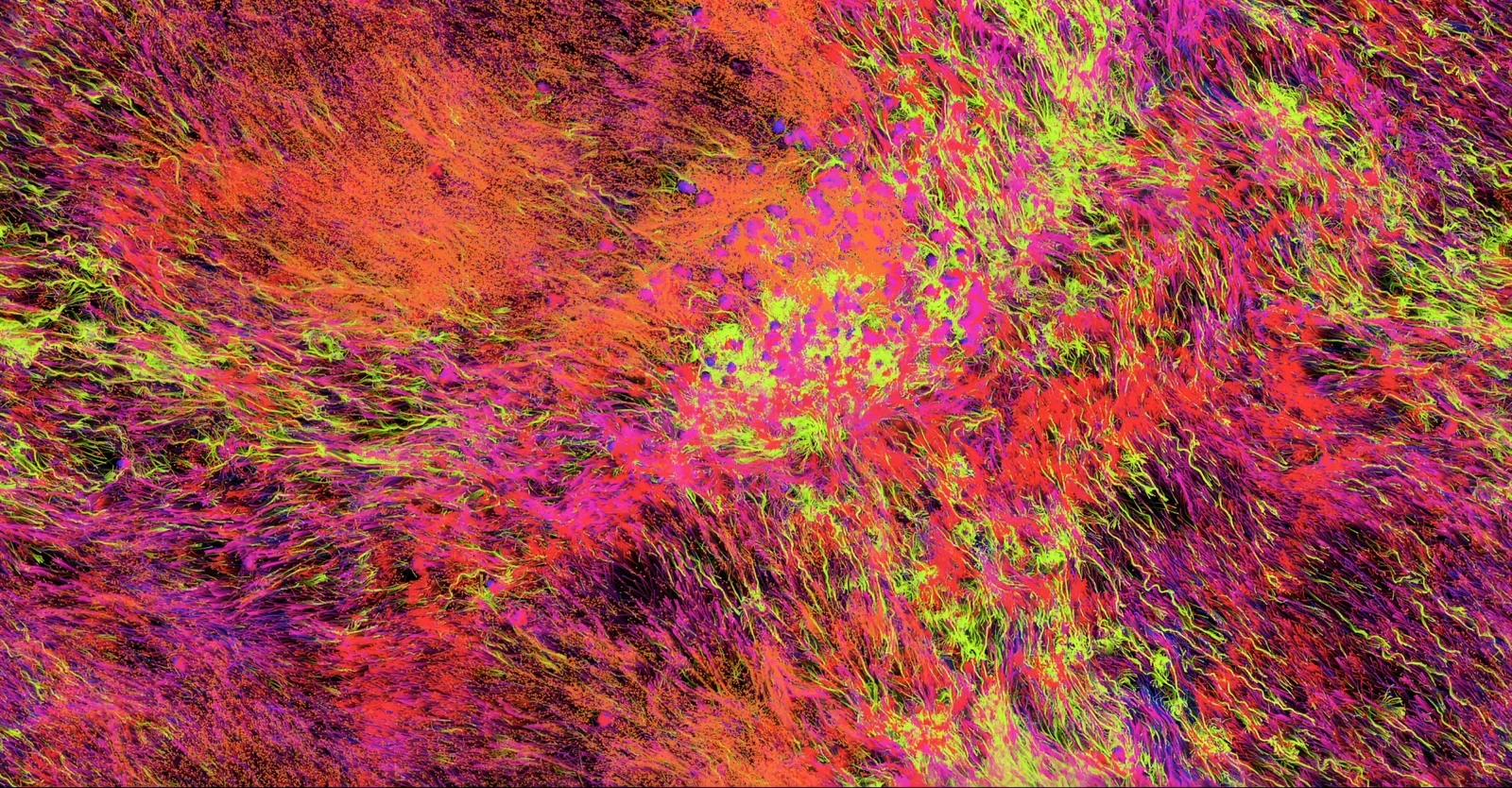
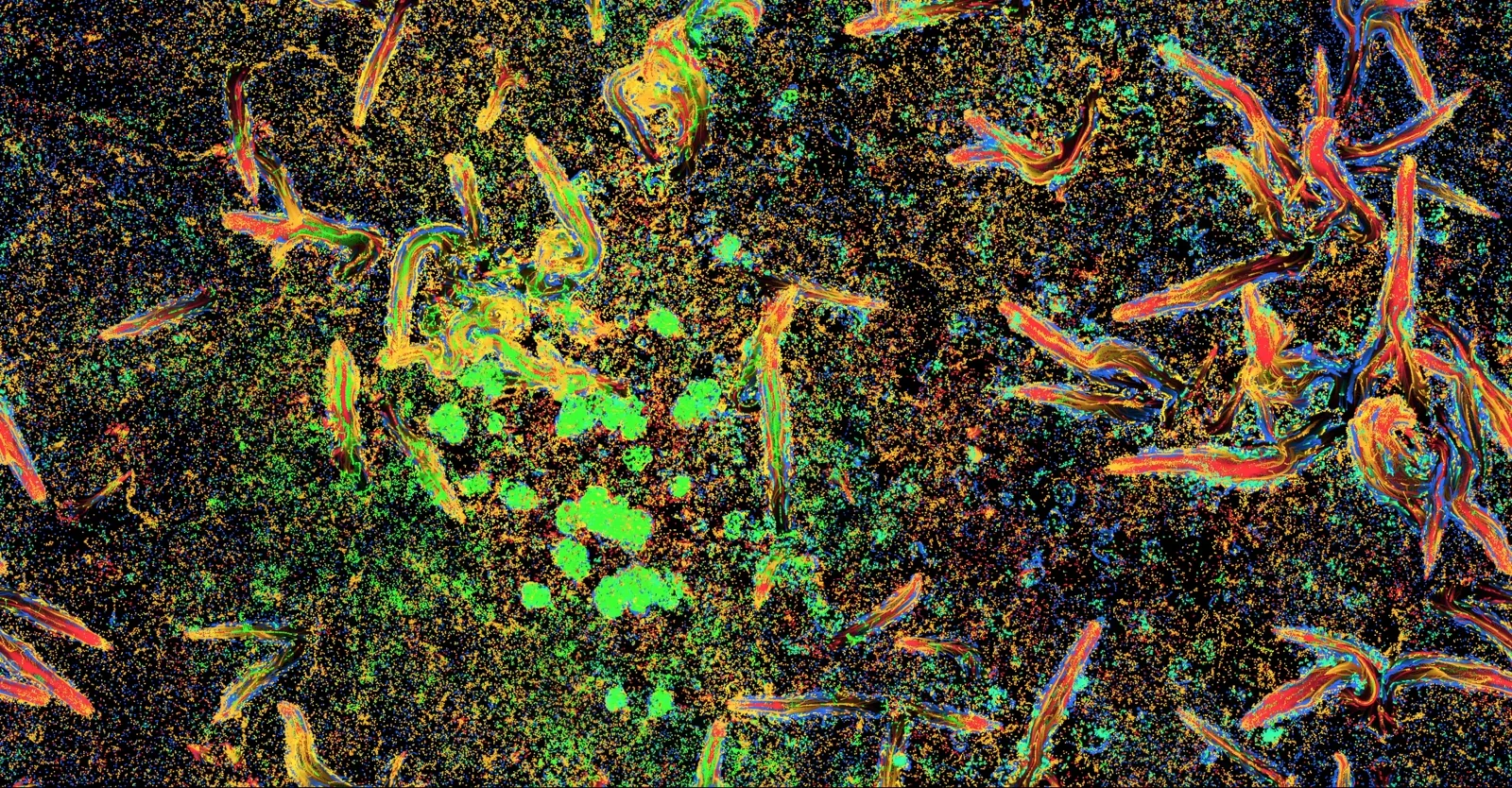 Hypercells, 4K autopilot build: 1,000,000 particles in a 3840 × 2160 field, dense filaments over black
How it works
The engine is a particle-life simulation in the tradition of physarum slime-mould models. Every particle writes velocity into a 2D field that decays each frame. Two mirrored sensors read that field ahead of the particle and to its side, and the difference between them is passed through an 80-float Fourier feature map that turns the reading into a steering direction. Changing those 80 numbers changes the organism, which is why the rule itself is the artwork rather than any single configuration.
Particles are split into colour cohorts, each steered by its own mutation of the shared rule, so several behaviours run in the same field at once and the image shows their boundaries as colour. An avoidance build adds a separate density field at half the flow-field resolution: each particle reads the density other particles left behind and turns away, with strength, radius and memory exposed as controls. Particle counts are selectable from 128k up to 1024k, and particle count and field edge scale together so the visual density stays constant.
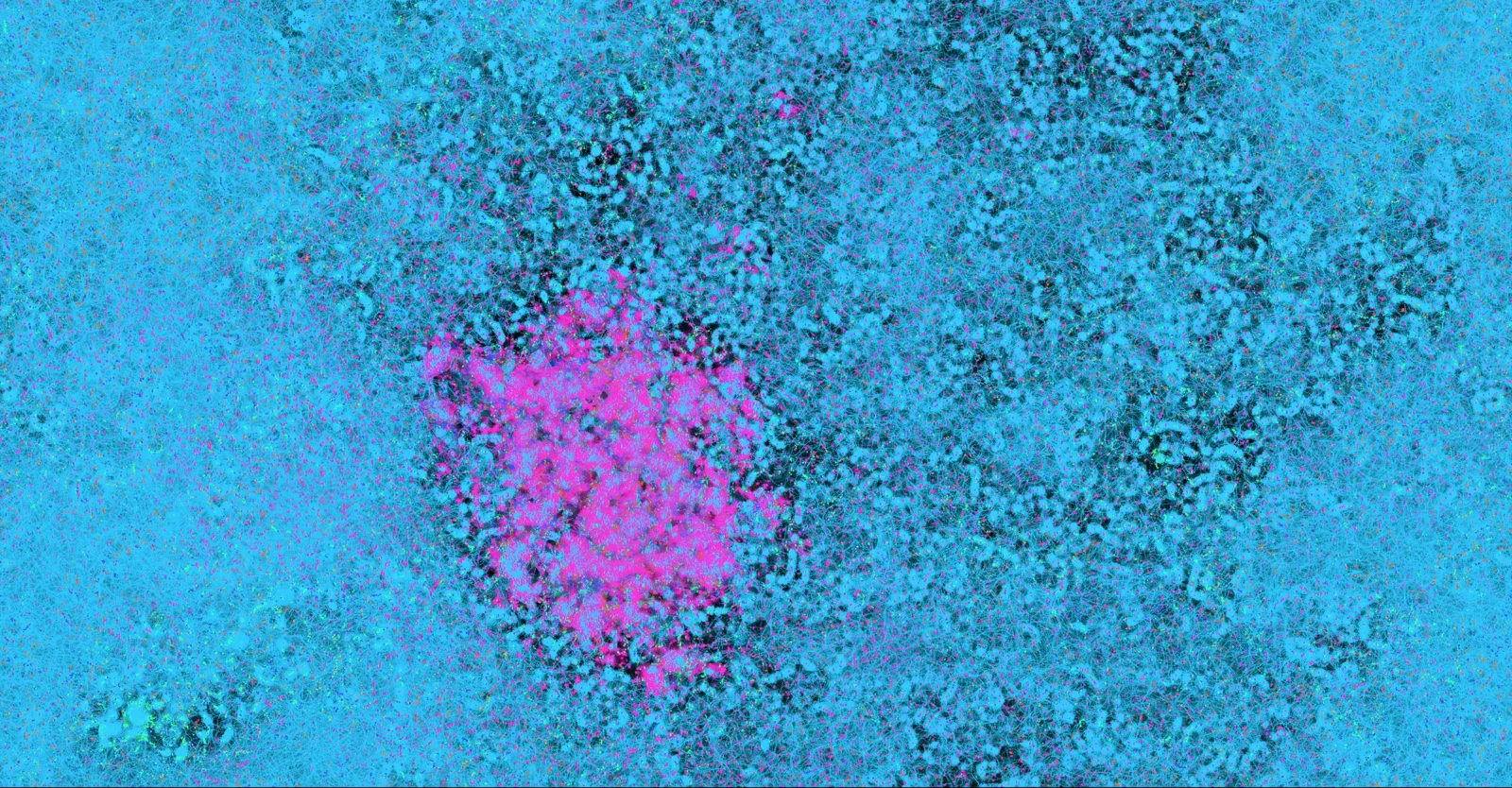
A third build puts the cohorts in competition. A MAX-blended dominance grid is computed over the field, each cell going to the strongest cohort roll scaled by population share, and beaten particles convert to the winner and are immune while their hue blends over one second. The round ends when the leader holds 99% or more of the particles; the winner's effective rule is then read back, re-mutated with a fresh seed, and the map is re-dealt into contiguous sectors, so the system keeps playing rather than settling.
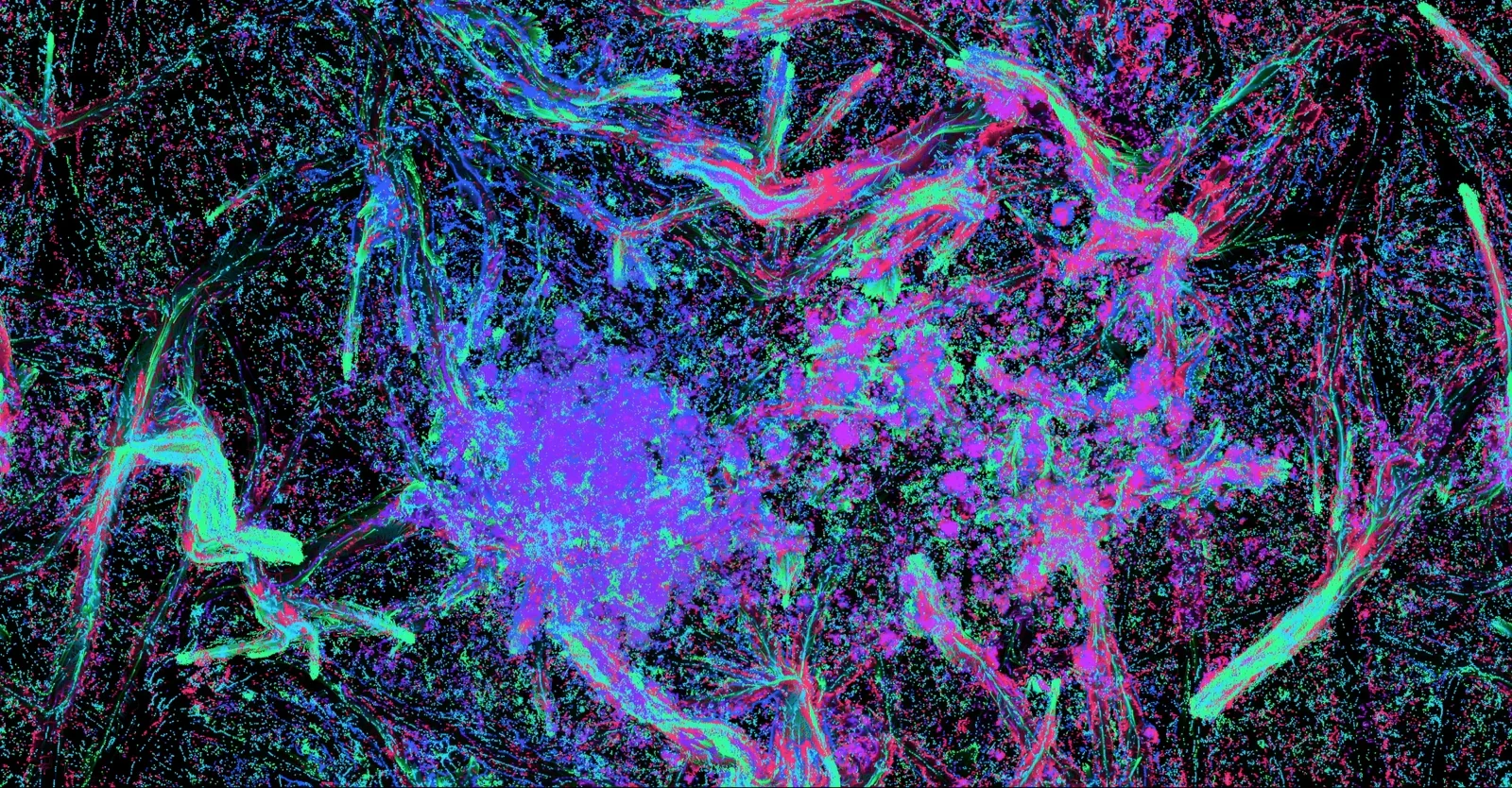
Rule evolution is automated. A localhost bridge serves the show to the display and runs an agent that reads the current behaviour shader, proposes a change, applies it, observes the result and keeps or reverts it, writing every accepted version to a numbered history and every proposal to a candidates folder with its outcome. The steering rule is therefore edited by a machine against the show's own behaviour rather than by hand.
The series runs at architectural scale as well as on screen. The 4K build presents 1,000,000 particles full-bleed at 3840 × 2160, and the same engine is tuned for realtime operation: on an integrated Intel UHD 630 GPU, the avoidance build was optimised from 81.5 ms to 11.9 ms per frame at 128k particles, and from 417 ms to 84 ms at 1024k.
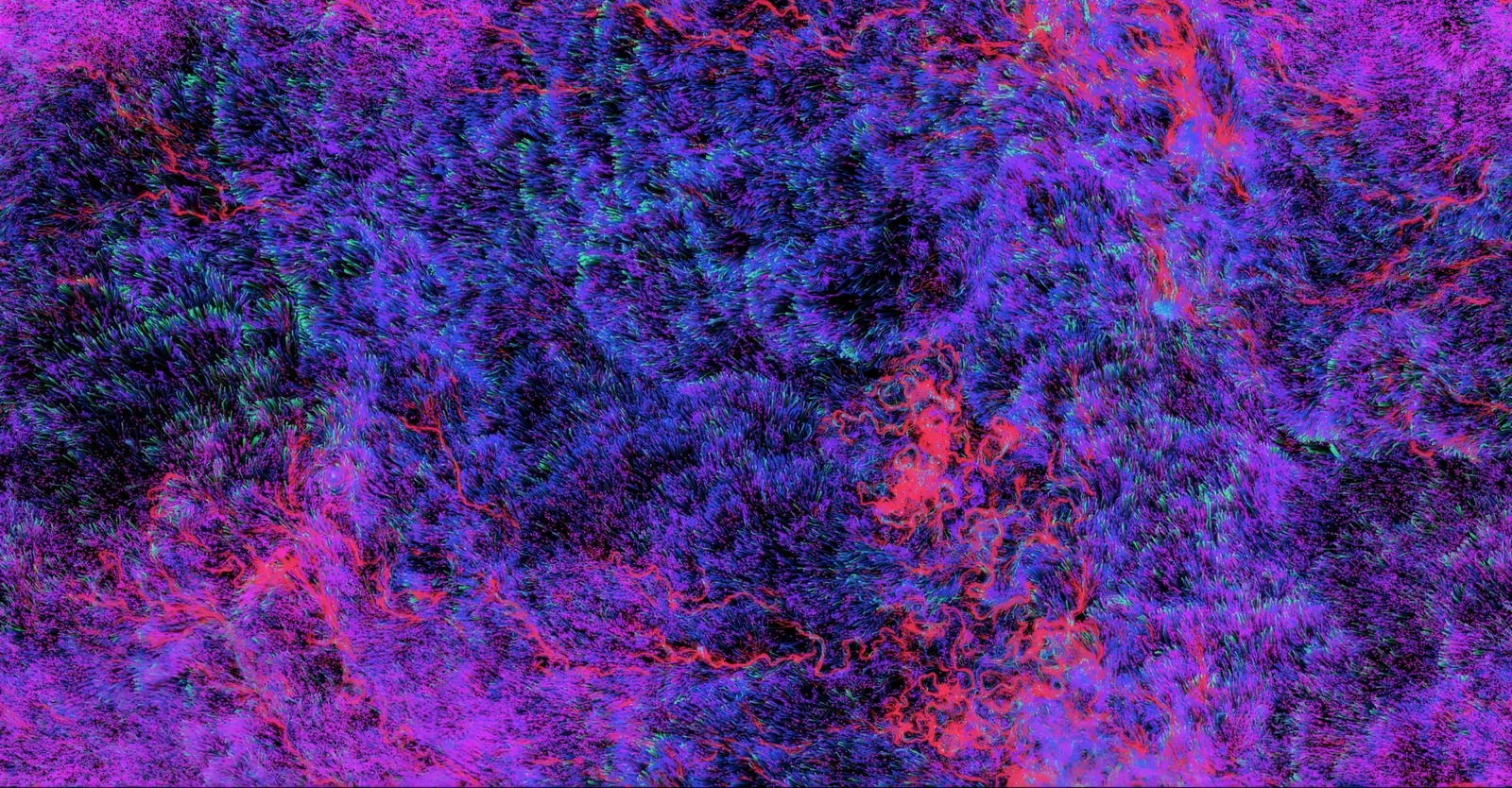
Every build is a single HTML file with no external assets, and every configuration is a JSON snapshot that can be saved and reloaded, so a run seen on screen can be reproduced exactly later. The series extends the studio's physarum and swarm-based generative work (Schwarm, 2007 onwards) into GPU particle systems, and it is developed alongside Hypercore, the studio's dense-texture generative AI series (2024).


